Published on
By Tanner O’Neal Riley
At 4 a.m. on summer mornings, most University of Missouri students are asleep.
This past summer, Caroline Kirby was getting ready for the day.
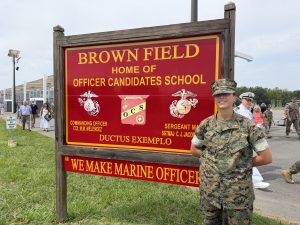
During Officer Candidates School, Kirby would wake before dawn, put her hair into a regulation bun and prepare for another day of physical training, leadership evaluations, academic testing and the uncertainty of not knowing exactly what would come next. For 10 weeks, she trained to become a Marine officer.
She came home with blisters, a faster three-mile time, a new community and a commission as a second lieutenant. But Kirby will say she has not made it yet.
“I feel very proud to be a second lieutenant, but I feel like there’s so much more to learn and to do,” she said. “I’m excited for the future.”
Kirby, a 2L at Mizzou Law, is preparing for a career that will combine two paths that might seem unrelated at first glance: the law and the Marine Corps.
The St. Louis native earned her undergraduate degree from Mizzou in information technology, with a minor in criminology and juvenile justice. During her junior year, she completed a cybersecurity internship.
She liked the work, she just knew she did not want to do it forever.
Law had always interested her, which was part of the reason she pursued her minor. At the same time, she had begun working with the Marines during her junior year of college and was considering military service after graduation if law school did not work out.
Then she discovered the Marine Corps’ judge advocate program.
The possibility of becoming a lawyer while serving in the military offered something she had been looking for: a way to build a career around both her interest in law and her desire to do something larger than herself.
“I want to do something in my life that fulfills me, something I can look back on in 10 years and be very proud and happy that I did something bigger than just myself,” she said.
That desire to test herself and serve her country runs through Kirby’s family. Her father served in the Army. An uncle served in the Marines. Both were enlisted, while Kirby chose a different path toward military service as an officer.
She said the Marine Corps’ reputation for demanding more of its people appealed to her.
“I also like a challenge,” she said. “And the Marines is probably the most challenging branch you could join. And I was like, if I can make it through the Marines, then I can do whatever I set my sights on.”
Learning to lead
Officer Candidates School gave Kirby plenty of opportunities to find out whether that confidence was justified.
The 10-week program tested candidates in three broad areas: academics, leadership and physical fitness. There were physical fitness tests and combat fitness tests. Candidates studied Marine Corps history, ranks, structure and important battles. They were evaluated while leading small units through simulated combat scenarios.
Kirby described it as basic training for officers, with an emphasis on learning how to lead.
Candidates might receive a five-paragraph order, brief their team and then lead them through a scenario requiring them to accomplish a mission or respond to a changing situation. The point was not simply whether the candidate could complete the task. It was whether they could lead other Marines through it.
Kirby said the physical demands were the hardest part.
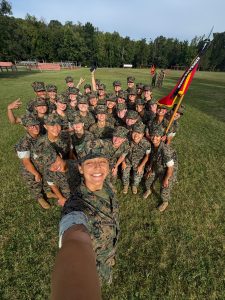
Her platoon was made up entirely of women. It began with about 65 candidates and finished with roughly 35. Many of those who left did so because of injuries, including hip injuries and strains.
The hikes were particularly demanding. Candidates carried more than 65 pounds while covering long distances, putting strain on their shoulders, hips and feet.
“I definitely didn’t prepare enough for those,” Kirby said.
Then there were the boots.
For someone unaccustomed to wearing them all day, every day, the transition could be painful. Blisters became another part of the routine.
Still, Kirby said the physical demands ultimately gave her something she had not expected. She left feeling capable of more.
“I feel so fit,” she said. “I feel like I could do anything.”
Her three-mile time improved by about two minutes during the training. Candidates also routinely walked around 20,000 steps a day. Physical training was woven into the schedule, sometimes with exercises after meals.
And then came the Forge.
The final week was designed as a culmination of the training, with candidates operating for roughly three days with little-to-no sleep.
Kirby remembers one night in particular, when it was around 2 or 3 in the morning. She was cold, wet and crawling through mud and water as part of a combat exercise. Water had seeped into her boots.
At that moment, she did not want to keep going.
“I just want to not do this,” she remembered thinking.
But she did.
Those moments became part of the lesson.
Kirby said she learned that she was more stubborn and determined than she had realized. She does not take failure well, she said. And once she had committed to OCS, she was not leaving voluntarily.
“If I’m going to do this, I’m going to make it through no matter what happens,” she said.
That determination mattered. So did learning that endurance is not necessarily about enjoying the hardship while it is happening. Sometimes it is simply about continuing until the hardship is over.
“Things will suck, but once you get out of it on the other side, there’s always a bright light,” Kirby said.
“You haven’t made it yet”
Kirby now wears the rank of second lieutenant. She has taken the oath. She has been commissioned. Technically, she is a Marine officer.
But OCS taught her not to confuse a milestone with an arrival.
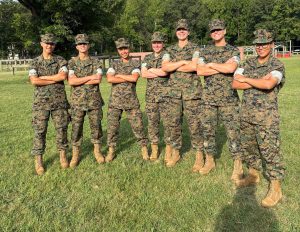
Throughout the 10 weeks, candidates repeatedly heard some version of the same message: You haven’t made it yet.
Even graduation did not completely erase it.
Kirby still has more training ahead.
After graduating from law school and passing the bar, she will attend The Basic School, a roughly six-month program where Marine officers learn infantry and combat skills. The expectation is straightforward: Every Marine should be prepared to deploy.
For Kirby, that means learning to be more than a lawyer.
She will then spend another 15 weeks studying military justice before beginning her work as a judge advocate.
The training reflects a larger Marine Corps philosophy Kirby encountered at OCS: Being an officer does not mean automatically knowing more than everyone around you.
Some of the Marines she will eventually lead may have years of experience. They may know things she does not.
The lesson she was taught was simple: Know when to lead and know when to listen.
“You do rank higher than the enlisted, but they do know more,” Kirby said. “They have more experience than you, and you have to earn their respect.”
That humility is part of what Kirby says she hopes to carry into her legal career.
She is proud of becoming a second lieutenant, but she does not see the rank as proof that she has arrived. It is a starting point.
A lawyer in uniform
As a judge advocate, Kirby could find herself working in a wide range of legal fields. Military lawyers can handle criminal matters, litigation, estate planning and other areas of law.
Exactly where Kirby ends up will depend partly on what the Marine Corps needs.
That uncertainty does not bother her. In fact, she likes it.
She is particularly interested in litigation and the prospect of eventually spending time in a courtroom. She also likes that a military legal career can allow her to move between areas of practice rather than spending her entire career doing one kind of work.
“You can stay in one area for a little bit and then you can move around to the next area,” she said. “You can be well versed in these different areas.”
That versatility could serve Kirby whether she spends a full career in the Marines or fulfills her initial service commitment and moves on.
She has not decided yet.
What she does know is that she wants the work to matter.
She has little interest in choosing a career simply because it is prestigious or lucrative.
For Kirby, the appeal of military service is not primarily the uniform or the title. It is the opportunity to serve, to be challenged and eventually to advocate for people who come to her for help.
As a judge advocate, she said, she is particularly excited about the prospect of advocating for Marines.
That is still down the road.
For now, she is a law student who happens to have a commission.
Finding a community
Perhaps the biggest surprise of OCS was not what Kirby learned about herself, but what she found in the people around her.
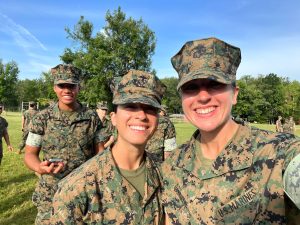
The women in her platoon became people she admired. So did her platoon staff and commander.
The experience gave Kirby a community of people who understand something that few others can. Some have already completed OCS. Others are preparing to attend. Some are still in training.
Kirby now helps lead a group of Marines and aspiring Marines at Mizzou who share that connection. She said that network has become one of the most valuable parts of the experience.
“You look out for them, they look out for you,” she said.
There is also something reassuring about being surrounded by people who are trying to do something difficult for the same reason she is.
Kirby wants to look back five years from now, after becoming a practicing judge advocate, and still feel the same sense of purpose that carried her through OCS.
She wants to be excited about her work. She wants to be proud of the path she chose. And she wants to be able to look back at the difficult moments and know they meant something.
That perspective has changed the way she thinks about the summer.
The early mornings. The hikes. The blisters. The mud. The exhaustion. The moments when she wanted to stop.
They were difficult.
But they were temporary.
What remains is the lesson.
“It might be really hard in the moment,” Kirby said. “But the life lessons that you get out of it, the leadership experience that you get out of it, it just makes it all so worth it.”
Kirby has already earned the rank. She has already survived the training. She has already taken the oath.
But if there is one lesson the Marine Corps left with her, it is that there is always another hill to climb.
For Kirby, the next one leads through law school, The Basic School, military justice training and eventually into a courtroom.
She is proud of how far she has come.
But she is not standing still.
“I’m excited,” she said. “There’s a lot to look forward to.”