Published on
By: Tanner O’Neal Riley
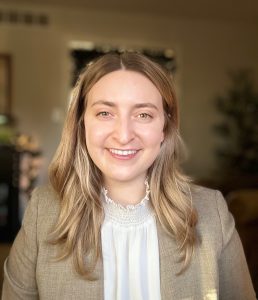
McKenna Thompson did not come to law school by way of a straight line. She came by way of forests and rivers — a path that began in wildlife biology and now runs through Missouri’s most privately held landscapes.
A 1L at Mizzou Law, Thompson is the co-author of “Understanding Landowner Perceptions, Enhancing Conservation Easement Adoption in Missouri’s Priority Landscapes,” a peer-reviewed, scientific paper that grew out of her master’s thesis research in the School of Natural Resources. The work sits at the intersection of ecology, property rights and public policy, asking a fundamental question: how do the owners of ecologically valuable property perceive conservation easements?
The answer, Thompson found, has less to do with resistance and more to do with information — or the lack of it.
“I think the biggest finding was that most of these landowners had not even heard of a very essential tool in keeping their property conserved forever,” Thompson said. “And when I was talking to many of them, a number said, ‘I can’t believe I never heard about this. I will absolutely look into this.’”
That tool is the conservation easement, a voluntary legal agreement that permanently limits certain uses of land to protect its conservation value. In a state like Missouri — where private ownership dominates the landscape — conservation easements can be one of the few legal mechanisms capable of preserving vulnerable ecosystems over generations.
“Missouri is so privately owned that if we want to protect these really vulnerable ecosystems, we need to look at private lands management,” Thompson said. “A conservation easement is, right now, one of the best ways to do that. It’s perpetual. It’s on the property forever.”
Thompson’s research was conducted in partnership with the Missouri Department of Conservation and relied on detailed geographic and land-use data to identify priority landscapes across eight regions of the state. From there, she contacted landowners directly, inviting them to participate in interviews — intentionally withholding mention of conservation easements until midway through the conversation.
The shift, Thompson said, was noticeable.
“About halfway through the script, I would say ‘conservation easement,’ and there would be a shift in the tone of the interview,” she said. “It was really interesting to see.”
Some landowners expressed concern or confusion, associating the word “easement” with government overreach or loss of control. Others were surprised to learn the agreements were voluntary and customizable. Many, Thompson said, were receptive once the concept was framed as a way to protect land for their families and successors.
“These are landowners giving up certain rights, which we know are deeply embedded in American conceptions of property and liberty,” she said. “And it’s amazing that within this demographic, they didn’t know about something that could be very beneficial for both themselves and society as a whole.”
The research did more than fulfill a degree requirement. It reshaped Thompson’s professional trajectory.
She was originally drawn to the Natural Resources program for fieldwork and wildlife ecology. But a natural resources policy course revealed a different lever for change.
“I realized that working with animals still meant I had to work with a lot of people too,” she said. “I realized that the most impactful change that I could make was by being in natural resources law.”
That realization carried her from rural Texas — a state she describes as “a hub of private land” — to Columbia, Missouri, where she is working to earn her third degree from the University of Missouri. When it came time to choose a law school, she cast a wide net, applying to 16 programs across the country. Mizzou Law, she said, felt like home.
“I picked Mizzou,” Thompson said. “They cannot get rid of me.”
Now in her first year of law school, Thompson sees her scientific research as foundational to her legal education and future work. She plans to continue writing, researching and exploring comparative land management systems, including international frameworks that balance private ownership with community and environmental interests.
“This is the threshold for my work now and my future work,” she said. “It helped mold what I want to do now as a legal professional — to respect private property rights while also thinking about society in the future.”
At its core, Thompson’s work is about bridging divides: between conservation and ownership, policy and people, science and law. She hopes it does more than inform agencies or academics.
“I hope that my work can inspire another young natural resources student to realize that a career in the law is also an option,” she said. “I hope it can inspire other states and countries to maybe take a look at private lands as a source of conservation that can ultimately help everyone.”
In many ways, that goal reflects Thompson’s own path. What began as fieldwork and ecological research has evolved into a broader effort to understand how policy, law and individual landowners shape the landscapes people depend on.
For Thompson, the work ahead will likely continue to blend science with legal analysis — asking how private land conservation can function not only as an environmental tool, but also as a partnership with the people who steward the land itself.
In a field often defined by regulation and resistance, Thompson’s research offers a quieter takeaway: sometimes, preservation begins not with enforcement, but with a conversation — and with making sure people know what tools are already within reach.
And if Thompson has her way, her legal career will continue exploring how different legal systems approach land stewardship, and how large-scale land management and landownership can work together to support both environmental sustainability and the people who depend on these landscapes.