Published on
by Tanner O’Neal Riley
In 1999, the University of Missouri School of Law established the first LL.M. in dispute resolution program in the United States. At a time when most graduate law degrees focused on tax, finance or intellectual property, Missouri charted a different path: training lawyers not just to litigate disputes, but to resolve them.
The choice was radical.
The program grew out of intellectual groundwork laid years earlier at the Center for the Study of Dispute Resolution, founded in 1984. Under leaders such as Len Riskin and later Professor John Lande, the center pushed legal education to confront a simple truth: Most cases do not end in trial.
“Legal education was focused on litigation and not necessarily giving people the tools and experience to do the things that most cases actually require,” said Professor Paul Ladehoff, who has directed the LL.M. program since 2011. “Most cases are a negotiated settlement.”
The LL.M. was designed to close that gap.
Unlike traditional graduate law degrees organized around subject matter, this program centered on method.
“This is a little different from other LL.M.s,” Ladehoff said. “It’s not a subject area of the law. It’s a practice. It’s a skill. It’s a method.”
From the beginning, the curriculum emphasized the theoretical roots of practice alongside practical mastery — public policy, dispute system design, ethical considerations and the architecture of conflict management itself. It invited lawyers to step back from individual cases and ask larger questions: How should systems handle conflict? What structures promote fairness? Where does human judgment matter most?
In 25 years, the program has attracted more than 389 attorneys from across the United States and more than 38 countries. Alumni have gone on to become mediators, arbitrators, judges, scholars, policymakers and institutional leaders. Some have returned home to build dispute resolution programs in their own nations.
One of them was Art Hinshaw.
Now associate dean for experiential learning and faculty director of the Lodestar Dispute Resolution Center at the Sandra Day O’Connor College of Law, Hinshaw was part of the first LL.M. class at Missouri.
“Being part of the first LL.M. class at Mizzou was truly transformational,” he said. “The people and relationships from that year profoundly shaped who I am, both personally and professionally.”
He began with only a tentative direction.
“I entered the program with only a vague goal of working in mediation, and the results have far exceeded my expectations.”
The program sharpened more than his resume.
“The LL.M. program sharpened my thinking, strengthened my writing, and gave me the direction and confidence that made my career as an academic possible,” he said. “I am most thankful.”
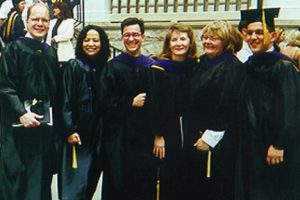
The first cohort also included Donna Pavlick, who would go on to spend more than two decades in legal education, eventually retiring as dean of student affairs and dean of students at the USC Gould School of Law.
“In thinking back on the 25 years since receiving my LL.M. in Dispute Resolution, I feel privileged to have been selected as a member of the first class,” Pavlick said. “It was an exhilarating and intense year as we learned from outstanding scholars, including Professors Len Riskin and Chris Guthrie, and forged the pathway for future classes.”
She credits the mentorship and relationships formed during that inaugural year with shaping her career.
“I was particularly blessed to have been mentored by Len and Chris, and to have made lasting friendships with several of my classmates and some who followed,” she said. “The experience provided a new world of possibilities and launched my career in legal education. I am forever grateful.”
From Cohort to Global Network
In its early years, the program followed a tight-knit cohort model — typically about a dozen students progressing together through an intensive one-year curriculum. The scale may have been small, but the ambition was not.
“There was skepticism,” Ladehoff recalled. “Is this a proper topic for an LL.M.? Most other LL.M.s were specialized subject areas. And you don’t need an LL.M. to serve as a mediator.”
The faculty had to articulate the difference between short-term skills training and a graduate degree.
“You can live a good and satisfying life as a mediator without an LL.M.,” Ladehoff said. “But there’s a reason to come here — to understand more deeply the why behind what you do.”
The program consistently ranks among the top five dispute resolution programs nationally. Even as overall law school rankings fluctuate, the specialty has remained a flagship strength.
“In Dispute Resolution, our small state school regularly compares well with much larger private schools like Harvard and Pepperdine.” Ladehoff said.
Growth accelerated in 2019 with the launch of an asynchronous online LL.M. in dispute resolution.
“When we turned on the online program in 2019, we’ve just been growing leaps and bounds,” he said.
The online format made the program accessible to working professionals and international students who could not relocate to Columbia. In fall 2025, 29 LL.M. students were enrolled in 160 credit hours of coursework, generating more than $150,000 in revenue. Enrollment has more than doubled over the past decade.
Expansion has been both deliberate and strategic:
- An LL.M. in American Law launched in 2017, with a new iteration scheduled to begin in fall 2027.
- Two graduate certificates debuted in fall 2020:
- Organizational Change and Conflict Management (with Public Affairs)
- Dispute Resolution for Non-Lawyers.
- In fall 2023, the school introduced a Spanish-language online LL.M. in dispute resolution, partnering with institutions in Venezuela, Colombia and Ecuador.
The aim is not simply growth for its own sake, but reach — extending the tools of dispute resolution across borders and professions.
Dean Paul Litton said the program has become one of Mizzou Law’s defining institutional strengths.
“The creation and growth of our dispute resolution LLM program over the past 25 years has elevated Mizzou Law into a national leader in preparing lawyers and professionals to solve complex conflicts,” Litton said. “What began as a focused academic offering has become a defining strength of the school, expanding our reach and strengthening our impact across Missouri and beyond.”
Technology, Judgment, and the Human Core
As legal practice evolves, so does the curriculum.
“How has technology changed the practice of dispute resolution? That’s really the focus,” Ladehoff said.
Long before the pandemic normalized Zoom mediations, faculty were exploring digital courts, online negotiation platforms and technology-assisted triage systems.
Now artificial intelligence presents new questions.
“AI can summarize documents or draft a motion,” Ladehoff said. “But there’s still judgment. There’s still a human understanding of people. Those are things AI doesn’t have.”
He does not view AI as an existential threat to lawyers, but as a tool requiring thoughtful integration.
“It’s going to replace some of the work lawyers do,” he said. “But there’s still work for lawyers.”
That balance — innovation rooted in human judgment — reflects the program’s broader philosophy.
Studying Peace
When asked to describe the program’s ethos in a single sentence, Ladehoff distilled it plainly:
“People concerned with peace-building, studying and learning skills to do it.”
For Professor Carli Conklin, director of the Center for the Study of Dispute Resolution, the defining impact of the program is not only the curriculum, but the people who pass through it.
“The people,” she said. “I still remember standing before my very first LL.M. in dispute resolution class of students in 2010.”
What struck her immediately was the shared dedication in the room.
“What I have experienced with the students in the classroom has been a combination of deep commitment to the principles of dispute resolution alongside a deep commitment to challenging professional training.”
That culture, she said, has created enduring connections.
“I have seen the impact of our student-first culture in the way our alums reach out to us by email, when they’re in Columbia, or at national conferences simply to update us on their lives years after they have graduated.”
The program’s strength, she argues, lies in how it bridges theory and practice.
“Mizzou Law has a long-standing history of merging dispute resolution theory with practice,” Conklin said. “We aim to train students to think well and practice well.”
Many graduates, she noted, go on to leadership roles across the field — in mediation, arbitration, public policy and academia.
“The success of our model is highlighted by how many of our students go on to leadership positions in their fields.”
Looking forward, Conklin believes dispute resolution will become even more embedded across the legal profession.
“No longer is dispute resolution a distinct and separate alternative to the work conducted in traditional legal practice,” she said. “Instead, dispute resolution is increasingly embedded within subject-specific areas of law.”
That shift, she said, will shape the next generation of training.
“We are excited to support today’s legal professionals as they seek to enhance their client advocacy by integrating their legal expertise with advanced knowledge and skills in dispute resolution.”
On the program’s 25th anniversary, Ladehoff reflected on the legacy of those who built it.
“I’ve been so grateful to have been part of what some really fantastic people had the vision to create,” he said, referencing pioneers such as Riskin and Lande.
But his pride rests most heavily on the alumni.
“I think of all of our alumni and the force multiplier effect,” he said. “They’re all out there taking what they got from this program and extending it. That just feels like a force for good in the world.”
The next 25 years will demand adaptation — to technology, to globalization and to civic strain. The original gap the program filled has narrowed; negotiation and mediation are now standard components of legal education. The task ahead is different: deepen, extend, refine.
“It’s not going to be doing the same thing we did the last 25 years,” Ladehoff said. “It’s going to be moving with whatever these changes are and applying it in new areas.”
But the foundation is solid.
The first program of its kind in the nation began with a belief that lawyers could be trained not only to win disputes, but to manage them wisely.
A quarter-century later, that belief remains.