Published on
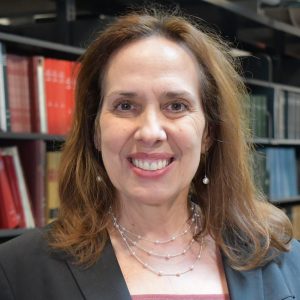
by Tanner O’Neal Riley
Professor Andrea Boyack continues to advance legal scholarship that bridges theory, teaching and practical policy challenges, with a focus on housing, consumer protection and economic inequality. Her work – including her two current book projects, classroom engagement innovations, op-eds, and comparative research – offers insights into how law shapes everyday life.
Professor Boyack is writing an ambitious book called Framing Housing Law and Policy, a project based on collaborative research with retired Professor Tim Iglesias of San Francisco. The book will examine how the way legal rules are conceptualized (or “framed”) affects both policy and outcomes.
“Framing is about the lens you use to see law, and that lens shapes what you notice and what you ignore,” Boyack said. “It’s not just about the rules themselves—it’s how we structure the conversation that matters.”
By delving into the concept of framing as well as five distinct housing “frames,” Boyack hopes to demystify how legal definitions, policy design, and interpretations influence opportunity and fairness. “Even small choices in how you frame a law can change the entire picture of who benefits and who doesn’t,” she added.
Professor Boyack’s forthcoming casebook, Contemporary Property Law, also prioritizes real-world impacts and strives to equip students to grapple with not only the content and application of legal doctrines but with the implications that flow from the content of our laws.
The role of the law in peoples’ lives has informed Boyack’s scholarship on consumer contracts as well. She has examined consumer debt, deregulation, and how contract law increasingly governs access to essential services.
“So much of our commercial activity is governed by private contracts, and people don’t even realize the extent to which they’ve agreed to whatever the other side wants,” Boyack explained. Her recent research demonstrated that every company’s online terms and conditions include clauses permitting the company to make changes to the rules governing the relationship whenever they want to. She highlights automatic renewals, subscription arrangements, and other terms that often strip consumers of meaningful choice, demonstrating how law intersects with ordinary life.
“The law of contract is supposed to reflect choice, but in practice, people often have no meaningful ability to negotiate terms,” Boyack said, highlighting the gap between legal theory and everyday reality.
One of Boyack’s recent articles, Just Consumer Financial Protection: Prevention or Cure, compares U.S. and European approaches to regulating and providing solutions to consumer debt, creating distinct societal outcomes.
Boyack first started writing on housing and consumer protection in the wake of the 2008 foreclosure crisis, a financial catastrophe that caused widespread loss of homes and wealth. She emphasizes that the financial crisis, much like our current crisis of extreme wealth inequality, was a product of systemic incentives rather than individual failure.
Boyack’s current research continues to examine how legal structures shape economic outcomes and what changes are necessary to ensure that people are afforded equal economic opportunities. Her work underscores the importance of analyzing inputs—laws, regulations, and incentives—rather than simply critiquing outcomes. She believes that chronic problems in the US legal and economic system must be diagnosed and treated at their cause rather than simply attempt to address the symptoms.
Economic inequality remains a central theme in Boyack’s scholarship. Although most people have a general sense that the US economy is becoming more unequal, Boyack claims that people find it difficult to understand just how unequal the wealth distribution is. Using a striking illustration, Boyack demonstrated the nearly unimaginable gap between having some wealth, like a million dollars and having “obscene” levels of wealth, like a billion or a trillion dollars. Boyack said, “A million seconds is twelve days. A billion seconds is 32 years. A trillion seconds is more than 31,000 years – which is as long as humans have existed on this planet.” Boyack sees extreme concentration of resources as a key factor in restricting access to housing, consumer credit, and other economic opportunities.
Boyack also draws connections between law and everyday experience in her teaching. Students in her courses explore how contracts, property rules, and legal frameworks affect ordinary Americans, combining theoretical perspectives with applied exercises.
The imperative of effectively and sustainably addressing the causes of financial precarity and risk inspire Boyack’s academic writing, her forthcoming book on housing, her legal scholarship, her teaching philosophy, as well as her media commentary and op-eds.
“You’re not going to solve everything in your lifetime,” said Boyack, “but you can understand the system and think about ways to make it better.”